
Ecclesiastical Licensing: What It Is and How It Supports Professional Identity
Guardian Ecclesiastical Holistic Association ecclesiastical licensing provides U.S.-based practitioners with a clear professional identity and lawful scope outside state medical licensure. It defines boundaries, supports transparency, and reinforces confidence without implying medical authority. Ecclesiastical licensing is about legal structure and identity, not certification or clinical permission.
 Many natural health practitioners feel confident in their education, skills, and philosophy, yet still experience uncertainty about how their work fits into a legally recognized professional identity. This uncertainty is not about competence. It is about structure, scope, and how one is formally positioned within the U.S. legal landscape.
Ecclesiastical licensing exists to address that gap. It provides a defined legal and professional identity framework for practitioners whose work does not align with state medical licensure models, particularly within holistic, faith-informed, or natural wellness practices.
This article explains what ecclesiastical licensing is, how it functions in the United States, and how it supports professional identity without implying medical authority or state licensure.
What Ecclesiastical Licensing Means in the U.S. Context
Ecclesiastical licensing is a form of professional recognition issued through a faith-based or ecclesiastical authority rather than a state regulatory board. In the United States, ecclesiastical bodies are legally recognized entities with the authority to establish internal professional standards, roles, and scope definitions for those operating within their framework.
Unlike state licenses, ecclesiastical licenses do not authorize the practice of medicine. Instead, they define a legal scope of practice that is rooted in religious freedom, spiritual counseling traditions, and natural wellness philosophies. Within the natural health field, this structure offers clarity for practitioners who work in non-medical modalities such as lifestyle guidance, spiritual wellness support, holistic education, and faith-informed natural health services.
How Guardian Ecclesiastical Holistic Association Provides Ecclesiastical Licensing
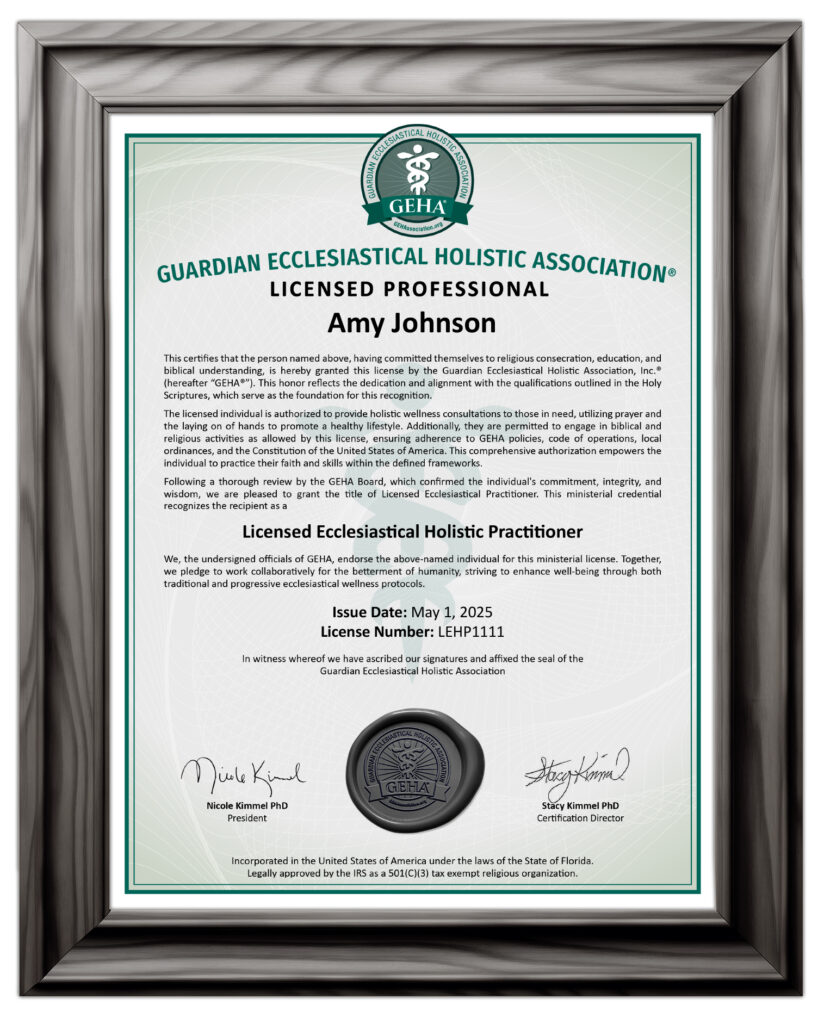 GEHA serves as an ecclesiastical licensing body specifically structured to support natural health practitioners operating within the United States. Its role is not educational and not certifying. Its role is based in identity and legal structure.
Through ecclesiastical licensing, GEHA:
- Establishes a clear professional identity category for natural health practitioners
- Defines legal scope boundaries that avoid medical or diagnostic claims
- Provides documentation framework that support compliance and transparency
- Reinforces the practitioner’s position as operating within an ecclesiastical model, not a state medical system
This distinction is critical. Ecclesiastical licensing is about legal positioning and clarity, not permission to perform regulated medical acts.
Ecclesiastical Licensing Versus Board Certification
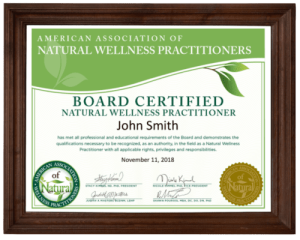
A common source of confusion is the assumption that licensing and board certification serve the same function. They do not.
Board certification evaluates education, training, or competency standards. Licensing defines legal scope and professional identity.
A practitioner may hold board certification without ecclesiastical licensing, and a practitioner may hold ecclesiastical licensing without board certification. These pathways are independent and serve different purposes.
The Role of Legal Scope in Professional Confidence
Legal scope is not about restriction. It is about clarity. Practitioners who understand their defined scope are better equipped to:
- Communicate their role clearly to clients
- Avoid language that could be misconstrued as medical practice
- Operate with confidence rather than fear or uncertainty
- Maintain consistency between services offered and professional identity claimed
Ecclesiastical licensing supports this clarity by formalizing scope language and reinforcing boundaries that protect both the practitioner and the client relationship.
 The LifeCare Agreement and Professional Boundaries
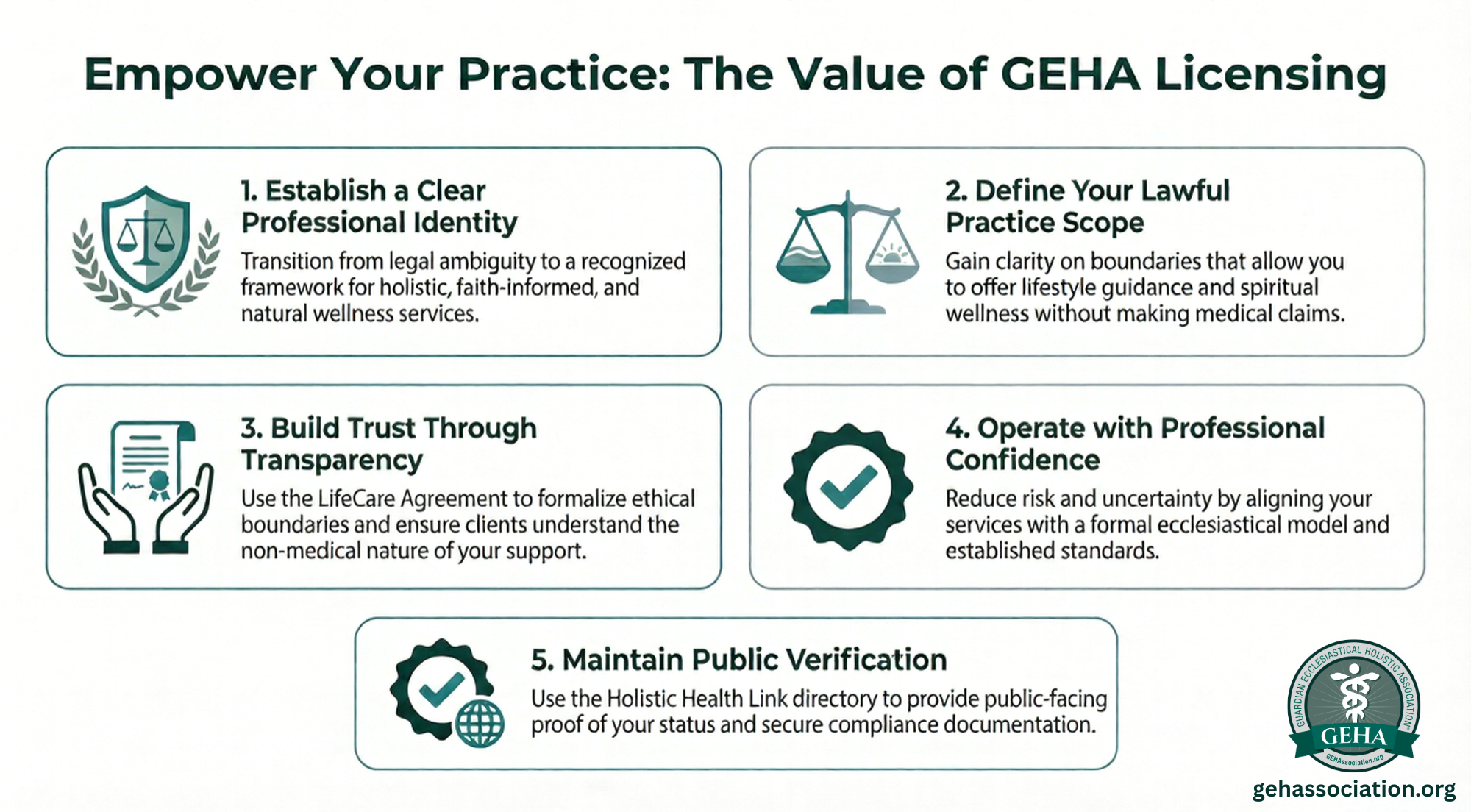
An essential component of ecclesiastical licensing through GEHA is the Lifecare Agreement. This agreement establishes clear expectations between practitioner and client regarding the nature of services provided.
Rather than functioning as a clinical consent form, the Lifecare Agreement:
- Clarifies that services are not medical treatment
- Defines the ecclesiastical and educational nature of the relationship
- Supports transparency and informed participation
- Reinforces ethical and professional boundaries
This documentation plays a key role in aligning practice behavior with ecclesiastical identity.
The Required Role of Holistic Health Link

For GEHA licensees, participation in Holistic Health Link is required. HHL is not a standalone service and is not marketed independently. It functions as the directory and compliance infrastructure that supports ecclesiastical licensing.
Through this required linkage, practitioners maintain:
- Public-facing verification of their ecclesiastical status
- Secure storage of Lifecare Agreements
- Ongoing documentation integrity aligned with licensing requirements
This structure strengthens defensibility and visibility without expanding scope or authority.
Who Ecclesiastical Licensing Is Designed For
Ecclesiastical licensing is often explored by practitioners who:
- Operate in holistic or faith-informed wellness models
- Do not seek or require state medical licensure
- Want legal and professional clarity within a recognized framework
- Value defined scope over ambiguous positioning
It is not a replacement for medical licensure, nor is it a credential of clinical authority. It is a structural solution for practitioners whose work exists outside regulated medical systems.
Professional Identity Without Medical Claims
One of the most important functions of ecclesiastical licensing is that it allows practitioners to hold a formal professional identity without implying diagnosis, treatment, or medical authority. This distinction protects practitioners from overreach while allowing them to operate openly, ethically, and confidently within their chosen modality.
Clarity reduces risk. Structure reduces confusion. Identity reduces uncertainty.