
Are You Considering Setting Up Your Own PMA?
Don’t Risk Your Practice With Untested Solutions
Before you invest time and resources into creating your own Private Membership Association, discover why hundreds of holistic practitioners choose GEHA’s established Ecclesiastical framework.
What is a pma really?
A Private Membership Association is a constitutionally-protected private organization that operates outside of public regulation by creating a private contractual relationship between members and service providers.
How a PMA Works
The Private Domain Concept
- When clients sign a membership agreement, they move from the “public domain” into the “private domain”
- This creates constitutional protections under the 1st and 14th Amendments
- All services, records, and interactions become private contractual matters rather than public regulatory issues
Key Constitutional Protection
- 1st Amendment: Religious freedom and freedom of association
- 14th Amendment: Due process and equal protection rights
- Church Autonomy Doctrine: Courts historically defer to established religious organizations’ internal governance
Why PMA Protection Matters
Legal Reality for Holistic Practitioners
GEHA’s PMA structure
How GEHA Operates as a PMA
- GEHA is a 501(c)(3) religious and charitable organization that functions as a Private Membership Association
- When clients sign the Lifecare Agreement, they automatically become free members of the GEHA community
- This moves them from public domain into private domain with full constitutional protections
The Lifecare Agreement System
- Unique contract between “Client Member” and “Licensed Ecclesiastical Holistic Practitioner”
- Clients acknowledge you do not diagnose, treat, cure, or prescribe
- Clients waive HIPAA rights, reinforcing the private nature of the relationship
- All records, notes, conversations, and forms remain confidential within the PMA
- Only accessible by the practitioner and client
Before you invest time and resources into creating your own Private Membership Association, discover why hundreds of holistic practitioners choose GEHA’s established Ecclesiastical framework.
The Protection You Need, The Legitimacy You Deserve
Why PMA Protection Matters More Than Ever
The Legal Reality Every Holistic Practitioner Must Understand
In today’s regulatory environment, holistic practitioners face increasing scrutiny from state licensing boards and regulatory agencies. A Private Membership Association (PMA) creates a constitutionally-protected private domain where your services are governed by private contract rather than public regulation. However, not all PMAs are created equal.
The Critical Difference
When clients sign GEHA’s Lifecare Agreement, they automatically become free members of our PMA community, moving them from the public domain into the private domain with full constitutional protections. All records, conversations, and forms remain completely confidential within the PMA structure.
Ready to Secure Your Practice with
Proven Protection?
Join Our Community of Protected Practitioners. Don’t risk your practice with an untested DIY solution.
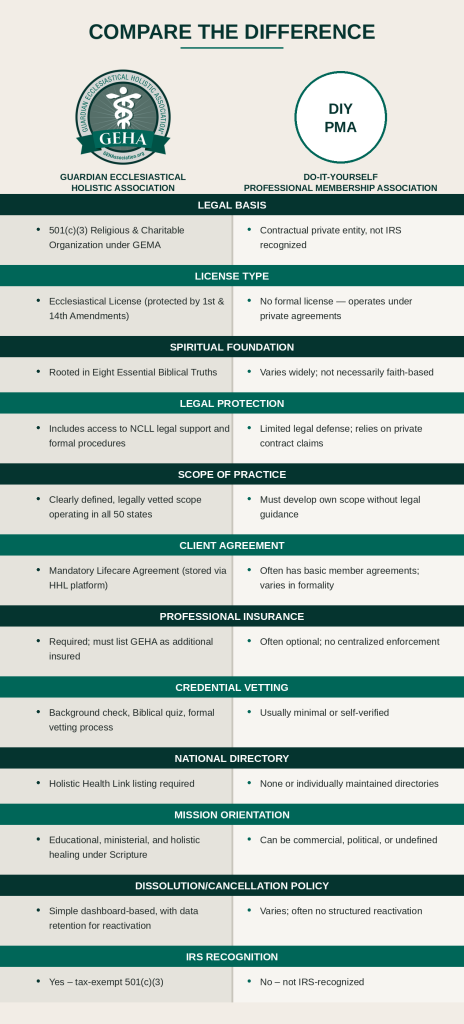
- 501(c)(3) Religious & Charitable Organization under GEMA
- Contractual private entity, not IRS recognized
- Ecclesiastical License (protected by 1st & 14th Amendments)
- No formal license —operates under private agreements
- Rooted in Eight Essential Biblical Truths
- Varies widely; not necessarily faith-based
- Includes access to NCLL legal support and formal procedures
- Limited legal defense; relies on private contract claims
- Clearly defined, legally vetted scope operating in all 50 states
- Must develop own scope without legal guidance
- Mandatory Lifecare Agreement (stored via HHL platform)
- Often has basic member agreements; varies in formality
- Required; must list GEHA as additional insured
- Often optional; no centralized enforcement
- Background check, Biblical quiz, formal vetting process
- Usually minimal or self-verified
- Holistic Health Link listing required
- None or individually maintained directories
- Educational, ministerial, and holistic healing under Scripture
- Can be commercial, political, or undefined
- Simple dashboard-based, with data retention for reactivation
- Varies; often no structured reactivation
- Yes – tax-exempt 501(c)(3)
- No – not IRS-recognized