
There Is a Defined Legal Framework for Your Practice – Here Is How to Step Into It
GEHA provides ecclesiastical licensing for U.S.-based natural wellness practitioners, establishing a defined legal scope for faith-based services. Most practitioners have never been told this framework exists. GEHA introduces a structured membership model that defines how services are offered, positioned, and supported. AANWP and AANWC Board-certified members are pre-qualified to apply, and membership includes practical benefits such as liability insurance pre-qualification and access to legal services.
You are already doing the work.
You sit with clients, listen carefully, and offer guidance shaped by years of training and lived experience. You have developed a rhythm in your practice. You understand what you offer, and the people you serve feel the difference it makes. There is real intention behind what you do, and it shows.
For many natural wellness practitioners across the United States, this is precisely where the professional story currently rests. Skilled, meaningful work is happening every day. And yet, for most practitioners, that work exists without a clearly defined professional framework that explains how it operates in a formal sense.

That absence is not a reflection of the practitioner. It is a gap in information. And it is a gap that can be addressed.
What most practitioners have simply never been told is this: there is a defined legal framework available for exactly the kind of work you are already doing. GEHA introduces that framework through ecclesiastical licensing. It does not change your work. It gives your work a defined professional community.
The Missing Piece Most Practitioners Never Realize Exists
Natural wellness is a field built largely outside of traditional systems. Practitioners come from diverse educational backgrounds, hold a range of specialties, and approach their work through different philosophies. Some have formal academic training. Others have accumulated years of applied experience. Many have both. What unites them is the work itself.
What has not been consistently available is a clearly defined professional framework that explains how that work operates, what boundaries it observes, and how it is positioned in a formal professional context.
Without that framework, practitioners often find themselves in a difficult position. Their services are meaningful but difficult to categorize formally. Their professional identity is clear to them but not officially defined. Their work exists, but without a recognized model that outlines its scope and context. This is not a failure of the practitioner. It is a gap in information.
Consider a practitioner who has been working with clients for six years. She holds a board certification through AANWP, operates a steady practice, and receives regular referrals. When a client asked her to describe the legal framework within which her services are offered, she paused. She knew what she did. She knew its value. What she did not have was a defined professional framework to point to. She learned about GEHA through a colleague, explored the GEHA guide to ecclesiastical licensing, and recognized immediately that the framework she had been looking for had existed all along.
Her experience is not unusual. GEHA exists to address exactly that gap, by introducing something most practitioners have never been shown: a defined ecclesiastical legal framework designed specifically for natural wellness services offered in a faith-based context. This framework is available exclusively to U.S.-based practitioners.

What Ecclesiastical Licensing Actually Defines
Ecclesiastical licensing is unfamiliar to many practitioners not because it is new, but because it has rarely been presented to this audience directly. That is beginning to change.
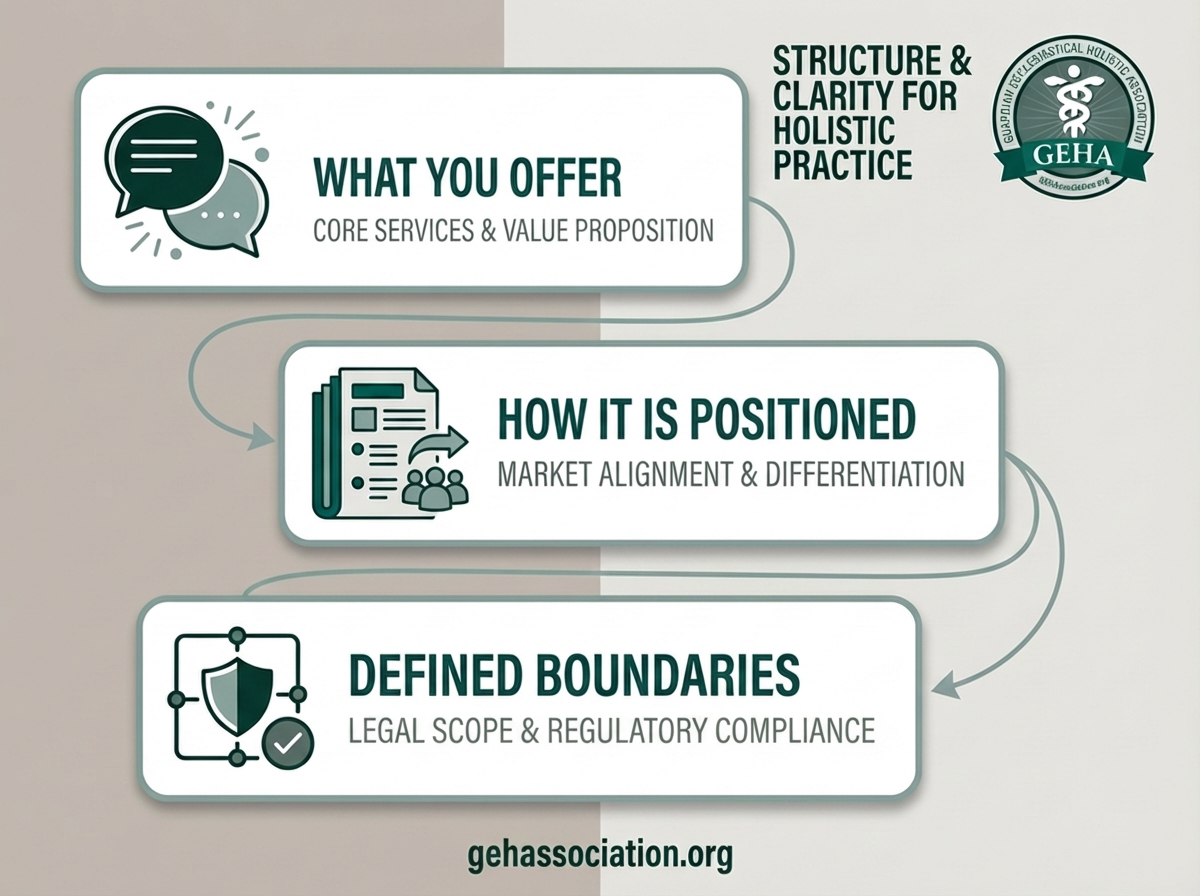
Within GEHA, ecclesiastical licensing establishes a defined legal scope for faith-based natural wellness services. It creates a professional framework that answers three essential questions: what you offer, how it is positioned, and the boundaries within which it is provided. This is not abstract territory. It is specific, intentional, and built for practitioners who are already active in the field or who plan to be.
The GEHA membership framework brings this clarity through a defined membership agreement that outlines how services are delivered, how they are described, and how they remain within a clearly established scope. It is not a general philosophy. It is a functioning professional model with defined edges.
To understand how this operates in practice, you can review the GEHA code of operations. What becomes clear is that this is not an abstract ideal. It is a specific model that practitioners can step into, and one that has been intentionally built for this field.
A Calm Distinction: Licensing and Board Certification
Part of what makes ecclesiastical licensing unfamiliar is that it does not fit neatly into the professional categories most practitioners already know. It helps to clarify what it is, and what it is not.
Board certification, whether through AANWP or AANWC, focuses on professional recognition. It reviews education, then establishes a credential that reflects a practitioner’s background and specialization. Board certification answers the question of who you are as a professional.
Ecclesiastical licensing serves a different and complementary purpose. It defines a professional framework within faith-based natural wellness services are offered. It introduces a clearly outlined model that connects your work to a defined scope and a membership agreement. It answers the question of how your services exist in a defined professional and legal context.
This distinction is not competitive. It is additive. Many practitioners choose to hold board certification and then step into GEHA licensing as a separate, clarifying layer. Board-certified members are pre-qualified to apply for GEHA licensing, which reflects how these elements work together without overlapping. To see how GEHA positions itself in relation to other professional approaches, review the GEHA comparison chart.
What Changes When Your Work Is Defined
The shift that occurs with ecclesiastical licensing is not about learning something new to do. It is about seeing your existing work through a defined lens.
When practitioners step into the GEHA membership framework, several things tend to change. Clarity of professional identity is the most immediate. Instead of relying on personal explanation to describe what you do and how it operates, your work is grounded in a defined framework that answers those questions with precision. The ambiguity that once required careful navigation is replaced by a clear professional model.
Alongside that clarity comes a defined set of boundaries. The membership agreement provides specific guidance on how services are delivered within scope, which creates consistency in how your work is both communicated and practiced. This is not a constraint. It is a foundation that supports confident, clearly articulated practice.
Practitioners who have gone through this process frequently describe a sense of alignment once they understand the framework. The work they were already doing, the services they were already offering, already fit within the model. Nothing changes in what they do. What changes is how it is positioned and understood by the people they serve.
GEHA membership also includes practical benefits that support the day-to-day reality of practice. These are not theoretical additions. They are direct extensions of the framework itself. You can review the full scope of benefits at gehassociation.org/membership-benefits.
Practical Benefits Most Practitioners Have Never Accessed
Because most practitioners have never been introduced to ecclesiastical licensing, they have also never accessed the practical benefits that accompany it. Those benefits are specific and meaningful.
GEHA members are pre-qualified for professional liability insurance through Lockton Affinity. This allows practitioners to obtain coverage with GEHA listed as additional insured. This is not a benefit that practitioners working without a defined professional framework typically have access to. Learn more about how this works at gehassociation.org/insurance.

Membership also includes access to legal services through the National Center for Life and Liberty. This covers unlimited legal questions and reduced membership rates structured specifically for practitioners operating within this framework. For practitioners navigating agreements, client communications, and practice operations, this is a resource with genuine day-to-day relevance.
The defined membership agreement itself is a practical asset. It outlines how your services are delivered and described, creating consistency in how your work is presented to clients, referral partners, and institutions. You can review the membership agreement overview at gehassociation.org/membership.
GEHA members also receive a Holistic Health Link directory listing with a custom URL for their practice. This provides visibility within a network of practitioners who operate within the same defined framework. For practitioners building referral relationships and professional visibility, this is a meaningful addition to their professional presence. This is also where the Lifecare Agreement is posted. This is the contract between you and your client, protecting your rights and theirs – with confidentiality and privacy.
A Framework That Has Always Been There
There is something important to recognize at this point.
This is not about becoming something different. It is not about stepping into a model that does not yet reflect you. It is about stepping into a framework that defines what you already are.
Natural wellness practitioners have always operated in a space that required its own professional model. The mainstream categories were not built for this work. Ecclesiastical licensing, through GEHA, provides a model that was. It introduces a defined legal scope for faith-based services, a membership framework that outlines how those services are delivered, and practical benefits that support the reality of practice. And it does all of this without asking you to change your work.
What once felt informal becomes grounded. What once required lengthy personal explanation becomes clearly defined. What once existed independently becomes part of a recognized professional framework.
That is the shift. And for practitioners who have been waiting without knowing what they were waiting for, it is the one that changes everything.
If you have been doing this work for any length of time, you already understand its value. The next step is making sure that value has a defined professional context to stand in. Explore your eligibility and see how your current work aligns with this framework.

Why Most Practitioners Have Never Heard About This
It is a reasonable question. If this framework is as specific and practical as it is, why is it not widely known? The answer is straightforward. Most practitioners are not searching for ecclesiastical licensing because they do not know it exists. Their attention is on building their practice, serving their clients, and developing their skills. GEHA content is designed as an introduction, not a correction. To learn more about the background and mission behind this work, explore GEHA’s story at gehassociation.org/about-geha.
The framework has been available. It simply has not been presented in a way that reaches practitioners where they are. That is what GEHA is designed to change. Most practitioners, once introduced to this information, describe the experience as a quiet realization rather than a dramatic shift. Nothing they were doing was wrong. They simply had not yet been shown that a defined professional community for their work existed.
For practitioners who want to understand the broader context of how ecclesiastical exemption and framework alignment operate together, the guide to ecclesiastical exemption is a direct and clarifying resource.